Design & Space
Empty Space And Why Rooms Need It
Gaps between objects are what let the eye separate them, so a room with too little empty space reads as cluttered even when everything in it is deliberate.

A room can contain nothing unwanted and still feel overloaded. What is missing in that case is not storage but space between things, which does visual work of its own.
Separation is what makes objects legible
The eye distinguishes objects by the boundaries between them, and boundaries require gaps. Items packed together are perceived as a single mass rather than individually.
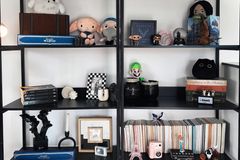
A shelf of books, ornaments and frames with no space between them reads as texture, and nothing on it is actually seen.
Removing a portion of the contents does not reduce what is noticed; it usually increases it, because what remains becomes visible.
Empty wall is part of the composition
Blank wall around a picture is what defines its edges and gives it presence, and the same picture surrounded by other objects loses that entirely.
Galleries hang work with generous space around it for this reason, and the principle transfers directly to a home even at smaller scale.
Which is why filling every wall tends to make a room feel busier without making it feel fuller.
Floor space carries the same effect
Visible floor between furniture reads as breathing room, and a layout that leaves clear paths feels larger than one of identical square footage packed to the edges.
Furniture on legs shows floor beneath it, which is why lighter-framed pieces make a small room feel more open than solid-based ones of the same size.
The furniture has not changed in volume, only in how much of the floor plane remains visible.
Surfaces need a defined limit
Flat surfaces attract objects, and a coffee table or console that is fully covered stops reading as a surface at all.
Deciding in advance that a given table holds three things, whatever those things are, keeps the surface functioning as one.
Restraint is harder than addition
Adding to a room is satisfying and immediate, while leaving space feels like something unfinished waiting to be filled.
Rooms that photograph well are usually notable for what has been left out, and the emptiness is a deliberate choice rather than an absence of ideas.
The practical version is to stop before the room feels complete and live with it for a while, since the missing thing is often obvious after a week and never obvious on the day.
Also by Ines Cardoso
- Growing herbs properlyPlants & Garden
- Buying less in the first placeOrganising
- Choosing and arranging artDesign & Space
- Dust, allergens and indoor airCleaning & Care