Organising
Organising a wardrobe
Most wardrobes contain a large proportion of items that are never worn, and identifying them is straightforward.
Surveys of clothing use consistently find that people wear a small fraction of what they own, and the unworn portion occupies the space that makes the worn portion hard to find.
Identifying what is actually worn
A method that removes the guesswork.
Turn every hanger to face the same unusual direction. When an item is worn and returned, hang it the normal way.
After several months, the hangers still reversed identify what has not been worn, without any judgement required.
A simpler version: move everything to one end of the rail, and return worn items to the other.
Most people are surprised by the result, and the exercise resolves the difficulty of deciding what to keep more effectively than any rule.
The categories that accumulate
Things that do not fit, kept in the expectation of fitting again.
The honest question is how long they have been there and whether their presence helps.
Things kept for an occasion that does not arise.
Things that need repair, which have been waiting for years.
A defined pile with a deadline resolves this: repaired within a month or removed.
Things that were expensive, which are kept out of a reluctance to acknowledge the money is gone.
It is gone either way.
Things that are almost right — nearly the right colour, nearly comfortable, nearly suitable.
These are the largest category in most wardrobes and are never chosen when there is an alternative.
The arrangement
What makes a wardrobe usable.
By category first, then by colour within it, which makes finding a specific item immediate.
Everything visible. Anything behind something else is functionally absent.
Folded items on edge rather than stacked, in drawers or boxes, so every item is visible and removing one does not disturb the rest.
This is the single most effective change available and costs nothing.
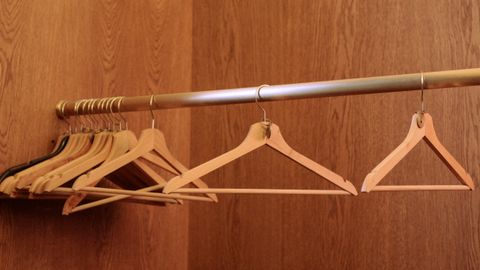
Matching hangers, which sounds cosmetic and which genuinely increases capacity because they take less space and hold garments consistently.
Slim non-slip hangers hold considerably more on the same rail than bulky ones.
Seasonal rotation where space is limited, with out-of-season items in deep storage.
The main benefit is that the current season's items are all visible rather than compressed among things that are not relevant.
What to do with what leaves
The step that determines whether the sorting is completed.
Good condition: charity shops, clothing banks, resale platforms, or giving directly to someone who wants them.
Worn out: textile recycling, which many local authorities and retailers now accept, and which handles items that are not wearable.
Textiles in general waste are a substantial and avoidable waste stream.
Whatever the route, it should leave the house within a week, since bags awaiting removal reliably return to the wardrobe.
Making clothes last
Which reduces the rate of accumulation.
Wash less frequently and at lower temperatures, discussed elsewhere on this site.
Hang or fold rather than leaving items in a pile, since creasing sets.
Rest shoes between wearings, which substantially extends their life.
Repair promptly, since a small tear becomes a large one.
Store knitwear folded rather than hung, which prevents stretching.
And use cedar or lavender rather than mothballs for wool storage, with the items clean before storing since moths are attracted to residue.
Buying differently
The upstream intervention.
The useful test before buying: what will this be worn with, when will it be worn, and is there something similar already.
A written list of genuine gaps, consulted when shopping, prevents most of the accumulation.
And a delay of a fortnight on non-essential purchases eliminates a substantial proportion, which is the most effective single habit available.
Storing things properly
Which affects how long clothes last as much as how easy they are to find.
Hang structured items — jackets, coats, shirts, dresses — on hangers with enough shoulder to support them, since wire hangers deform shoulders permanently.
Fold knitwear rather than hanging it, since hanging stretches it out of shape irreversibly.
Leave space between garments, since compressed clothing creases and does not breathe.
Store out-of-season items clean, since moths are attracted to body oils and food residue rather than to clean fabric.
Use breathable covers rather than plastic, which traps moisture.
And deal with moths by cleaning, vacuuming the wardrobe including cracks, and freezing affected items, rather than relying on repellents alone.
Also by Rosalind Mayer
- Finishing a room, and knowing when to stopDesign & Space
- Making a home work for how you actually liveDesign & Space
- Bread, and why it is worth makingKitchen
- Storage that is part of the roomDesign & Space