Plants & Garden
Indoor plants for difficult conditions
Dark rooms, dry heat, cold windowsills and neglect each have plants that tolerate them.
Most houseplant advice assumes reasonable light and consistent care. A great many rooms provide neither, and there are plants for those too.
Genuinely dark rooms
Where light is minimal — north-facing, a small window, or several metres from any glass.
Snake plant, which tolerates low light and infrequent watering better than almost anything and which is the standard recommendation for a reason.
ZZ plant, which stores water in rhizomes and survives extended neglect.
Cast iron plant, named for its tolerance and correspondingly slow.
Pothos, which trails and which will grow in poor light, though variegated forms lose their markings.
Peace lily, which tolerates lower light than most flowering plants and which signals its water needs by drooping visibly.
The realistic expectation in genuinely low light: survival and very slow growth rather than thriving.
Rotating plants — a few weeks in a darker room, then a period somewhere brighter — keeps them healthier than a permanent dark position.
Dry heated air
Which is most homes in winter, and which most tropical foliage plants dislike.
The tolerant ones are those adapted to arid conditions: succulents, cacti, snake plant, ZZ plant, rubber plant, dracaena and most palms.
The intolerant ones show brown crisp leaf tips: calathea, maranta, ferns and many tropical foliage plants.
Where those are wanted, grouping plants together and standing them on trays of wet pebbles raises local humidity, and a bathroom or kitchen is generally the best room for them.
Misting has a very brief effect and is largely a ritual.
Cold windowsills
Where the light is good and the temperature drops sharply at night.
Plants suffering here show sudden leaf drop or blackened patches where leaves touch the glass.
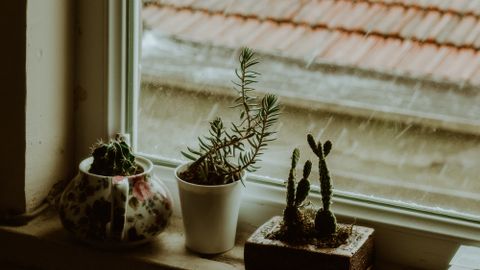
Tolerant options: many succulents, which come from climates with cold nights; cyclamen, which prefers cool conditions; and most bulbs.
The simple fix is moving plants off the sill on cold nights or closing curtains between the plant and the room rather than behind it, which traps the plant in the cold.
Neglect
Where the honest requirement is a plant that survives being forgotten.
Snake plant and ZZ plant again, which tolerate weeks without water.
Most cacti and succulents, provided they have light and sharp drainage.
Aspidistra.
Air plants, which require occasional soaking and no compost at all.
And, for anyone whose plants consistently die, a single well-chosen plant in the right position is a better proposition than a collection that is uniformly neglected.
Bathrooms
Frequently humid and frequently dark, which is a specific combination.
Where there is a window: ferns, which love the humidity; calathea and maranta; and orchids, which do well in bathrooms.
Where there is no window, no plant will survive without supplementary light.
Pets and children
A consideration that changes the selection.
Several common houseplants are toxic if ingested, in varying degrees — including many aroids, lilies, which are particularly dangerous to cats, and several others.
Where cats, dogs or small children are present, checking a plant before buying is worthwhile, and reliable toxicity lists are published by veterinary and poison information organisations.
Safer options generally include spider plant, calathea, most palms, boston fern and african violet.
Supplementary lighting
Worth knowing about, since it removes the light constraint entirely.
Modern plant lights are efficient and inexpensive, and a single fitting on a timer transforms what can be grown in a dark room.
The requirements: sufficient intensity, appropriate spectrum, and enough hours — generally twelve to fourteen a day for growth.
An ordinary room light does not provide this; a dedicated fitting does.
Which is the practical answer for anyone who wants plants in a room that cannot support them naturally.
Winter, which is the real test
Most houseplant losses happen between autumn and spring.
Light levels indoors fall dramatically, growth slows or stops, and the plant's water requirement falls with it — while heating dries the air and people water on the same schedule as summer.
The adjustments: water considerably less, checking the compost rather than following a routine; stop feeding until growth resumes; move plants closer to windows to compensate for lower light; and keep them away from radiators and draughty doors, both of which are harder on plants than cold alone.
Dropped leaves in winter are frequently a response to reduced light rather than a fault, and the plant recovers in spring provided it has not been drowned in the meantime.
General information only, not veterinary or medical advice. Check plant toxicity before buying if you have pets or children, and contact a vet or poisons service if ingestion occurs.
Also by Rosalind Mayer
- Finishing a room, and knowing when to stopDesign & Space
- Making a home work for how you actually liveDesign & Space
- Bread, and why it is worth makingKitchen
- Storage that is part of the roomDesign & Space